Free digital classic
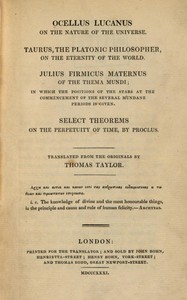
Ocellus Lucanus on the nature of the universe: Taurus, the Platonic philosopher, on the eternity of the world. Julius Firmicus Maternus of the thema mundi. Select theorems on the perpetuity of time, by Proclus.
Get Folarin Bookstore Digital on Google PlayAbout this book
Creators: Thomas Taylor (1758-1835) [Translator], Julius Firmicus Maternus, Proclus (412-485), Tauros (105?-), and active 6th century B.C. ho Leukanos Okellos [Dubious author] "Ocellus Lucanus on the Nature of the Universe" is a philosophical treatise likely written during the ancient classical period. This work presents an exploration of the nature of the universe and delves into the philosophical implications of existence, drawing from ancient thinkers such as Plato and Aristotle. The text reflects on the universe's timelessness and ungenerated nature, affirming its perpetuity against contrary notions of creation and dissolution. The opening of this treatise outlines Ocellus Lucanus's assertions regarding the universe's indestructibility and eternal existence. He argues that if the universe had a beginning, it could not perpetually exist, asserting that the universe is a whole that requires no external factor for its existence. Through a series of logical deductions, he reinforces the idea that all components of the universe maintain an inherent harmony, emphasizing the stability and self-sufficiency of the cosmos. Furthermore, the text sets a philosophical tone that invites readers to contemplate the nature of existence and the principles governing the cosmos, foreshadowing a deep inquiry into the relationships between the divine, nature, and humanity. (This is an automatically generated summary.) Reading Level: Reading ease score: 52.5 (10th to 12th grade). Somewhat difficult to read. Rights: Public domain in the USA. Downloads: 568